
For all that has been written about the Internet, most managers remain confused regarding its likely strategic impact on their businesses (internal perspective) and on competition in general (external perspective). Our aim, in this paper, is not to try to predict the likely technological evolution of the Internet. Rather, we set out to provide managers with a generic framework (the ICDT model) for understanding the opportunities and threats generated by the Internet - and for developing a strategy to leverage these. Before outlining this framework, we believe that it is useful to briefly consider how business is evolving. This will provide a platform for examining how the Internet may accelerate certain trends while revoking others.
Global business and the Internet
There was a time when resources and markets were generally co-located. A company would set up business where the resources - what used to be labelled the four Ms (men, machines, materials and money) - were readily available. It would use these resources to manufacture a product. It would then build up and serve a local (sometimes national) customer base.
Progressively "home" markets became saturated and companies started to export excess production to more distant markets - essentially, in descending order of GNP or cultural proximity [Hofstede 1985]. Growing demand from these markets sometimes warranted establishing a local sales office or manufacturing operation. Occasionally, it even led to a token R&D presence, to adapt the offering to local tastes.
Alongside the dispersal of markets, came the dispersal of resources. Initially, it was just a question of capitalizing on cheaper sources of materials or labour in remote locations - while the strategic competencies remained buried in-house. But over time, many of the overseas producers used the low-cost platform to build up real expertise in a particular domain with the result that pockets of excellence have sprung up around the world [Porter 1985] - a striking example being the emergence of India's software industry.
Finally, companies themselves have grown increasingly dispersed and decentralised in order to 'get close' to these emerging markets and technologies. Global coverage allows companies to be responsive to market needs and gives them rapid access to far flung strategic resources. At the same time, however, it impedes the internal flow of communication.
Dispersion on all fronts has therefore dramatically changed some of the rules of business competition. Companies no longer own all the key resources but must locate and access them; the attractive growth opportunities have to be actively identified as the domestic market is not necessarily the lead market; and corporate competencies are not all co-located at HQ but have to be pooled from distant nodes. All this puts a premium on the movement of information - internally and externally - as a competence. This is where the strategic value of the Internet lies. It can significantly enhance the quality of a company's linkages. Externally, it helps the company to sense new markets and to access new knowledge as these emerge. Internally, it allows information acquired or generated on the periphery to circulate throughout the group.
The other key feature of global competition is speed. Speed in detecting
markets, in the first place. Speed in finding out which are the required
resources and where they lie. Speed in internalising them and combining
them with existing competencies. And ultimately, speed in exploiting markets
before competitors acquire similar competencies. Here again, the Internet
promises to be a powerful weapon.
The Virtual Information Space (VIS) is about visibility. It operates like a large billboard. It shows who's who, what's available, how much it costs and so on. It may offer flexible access which allows visitors to "choose their own path" but it remains a one-way communication channel.
The Virtual Communication Space (VCS) is about interaction. Like a café, it is provides a "space" for engaging in relationship-building, exchange of ideas or opinions. The "space" itself can range from a simple chat-line to a sophisticated 3D space in which individuals "meet". Members of the virtual community can communicate at high speed, low cost, and bypass traditional physical and geographical constraints.
The Virtual Distribution Space (VDS) is about service delivery. As with the postal service, there are constraints on the types of items that can be delivered through this channel - it is only suitable for products and services which can be wholly or partly digitalized. Also the recipient takes "something" away, but payment itself happens elsewhere.
The Virtual Transaction Space (VTS) is about trading. It is a bit like a stock exchange in that goods and services are not transferred in this space - only orders, commitments, invoices or transfers of payment.
The ICDT Model is generic. It has already been used to diagnose the
Internet "maturity"/strategies of whole sectors, such as banking [Angehrn
& Meyer 1997]. It also serves to structure and detect opportunities
in individual companies. Our aim here is to use it to consider separately
how the Internet potentially improves a company's external linkages (with
markets and resources), and can be used to enhance internal communications
and processes.
Simply creating a Web site does little to stimulate interest. It establishes contact - but if if the aim is to connect with other economic agents then the information provided has to be pertinent. Relevance can be enhanced by customising the channel, so that the pages are tailored to user groups. For example, potential business partners may have very different company or product information needs from potential consumers.
But this is not a one-off effort. If the company wants people to return to the site, and to build up an on-going relationship, then it needs regularly to update the content of its pages. And that requires dedicated personnel, and investments in multimedia competencies.
Moreover, there is a lot of information to extract from monitoring the flow of visits to the site. Companies which take the trouble to compile and analyse this information may find it a cheap way of understanding customer preferences.
Communication space: The VCS presence of most companies remains underdeveloped because businesses are still not sure what objectives it might serve. Part of the problem, is that the interface with customers has traditionally been the responsibility of the marketing department - which is more used to broadcasting to than interacting with customers.
The VCS provides an opportunity for economic agents to exchange information and opinions through e-mail, in on-line forum discussions, or more advanced 3D- and virtual reality interaction spaces. Discussions among visitors regarding their experiences with the product and ideas relating to its usage may have an unforeseen payoff for the company. Besides helping to differentiate the product, it may also yield unexpected insights on possible product adaptations or highlight untapped market segments.
There is also a case for opening similar sites for corporate users - potential partners, suppliers, or distributors from within the same industry - who might interact in closed user groups, discuss industry trends via on-line forums, and formulate requests for meetings with company representatives. These social spaces would build up relationships and potential sources of information which might pave the way for future commercial collaboration - like virtual trade fairs. Of course, monitoring and contributing to such communication spaces may require the creation of new jobs.
Over time one can expect that this monitoring role will develop into a more proactive role aimed at opinion building or lobbying. With a high level of interaction outside its control, companies may need to find ways of influencing that opinion, not least to preempt unfounded rumours.
Distribution space: Exploiting the VDS potential of the Internet is primarily aimed at cutting costs and lead times. Of course, software and publishing companies have been particularly quick to latch on to the possibilities of dispensing with intermediaries and delivering their products directly. But the Internet can also be used to distribute to customers auxiliary services associated with "physical" products such as cars. Instruction manuals, customer support and consulting services, product-related training and updates - including digital pictures and music - can all be provided over the Web in ways that "augment" the value of the "core" product.
What is more, the Internet creates the possibility of offering new value adding services. Some companies have found that they can repackage the information they use to control their own processes and make this information available to customers as a service. A typical example is the magazine or newspaper which gives outside access to its archives - an activity which was initially designed to support the in-house work of its own journalists. Another example is the Federal Express service which allows customers to track their parcels on-line. This reduces the number of expensive calls to customer service representatives and has increased customer loyalty in a fiercely competitive market. More and more companies are pushing back the interface with the customer - putting back-office processes on display, rather in the way that restaurants sometimes let you see the chefs in action as part of the "eating experience".
Transaction space: the objective here is clear: to engage in business-to-business or business-to-customer transactions such as ordering, invoicing and payment. This has both revenue generation and cost reduction potential in that "disintermediation" facilitates order processing and shortens lead times. The cost of an Internet transaction, in banking for example, is a fraction of the same transaction at a bank branch.
Business-to-business transactions have benefited considerably from this channel. It allows companies to trigger automatic ordering, to invoice and make payments easily. This has been facilitated by EDI platforms which provide a high level of security to the transactions. In fact, many businesses are insisting that potential suppliers install EDI if they want to be considered.
Business-to-consumer transactions do not yet benefit from the same kind of security or reliability as offered by the EDI system. Currently, the huge potential for wide-reaching commercial activity with consumers is stifled by legal, security and reliability concerns.
The commercial activity so far has typically been limited to low value purchases like software, books, music, and magazines. One such example is Virtual Vineyards a Web-based service that sells wine, mostly from small vineyards. Visitors can purchase directly from the company using an on-line form. A more secure system is proposed by IBM which enables visitors to browse through a catalogue of products via the Web and then place orders interactively via a Secure Credit Card Information Form. With many companies looking into ways of improving security, it is only a matter of time before on-line transactions explode.
Once security can be guaranteed, a company will simply need to hook
up its Internet site with its internal accounting system or other transaction
processing systems. This is an advanced type of application which will
demand heavy investments.
Intranets are protected from outside users by establishing physical filters between networks, known as fire walls. The level of access to the intranet can be adjusted in function of the user's status, so that members of the "extended enterprise family" (suppliers and other partners) have more restrictions than members of the "nuclear family" (employees) - and access may be further differentiated depending on position with the firm.
The ICDT model can be used to in this context to describe the new space of opportunities available to companies for increasing the efficiency and effectiveness of organizational agents through the set-up of appropriate Intranet/groupware platforms [Gow 1996]. Again, this spaced of opportunities can be divided into four separate "Virtual Spaces" as illustrated in figure 2.
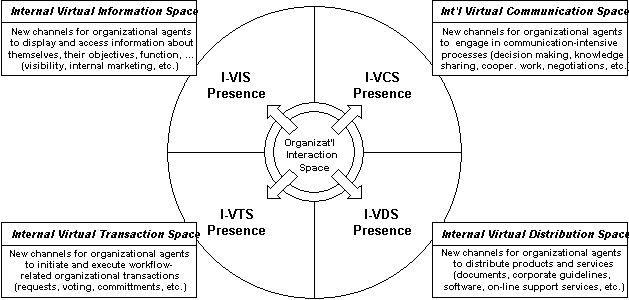
Information space: In contrast with the widespread use of the VIS externally, internally it is pretty much neglected. Companies do not tend to go to much trouble to let employees know who is who or who does what, beyond providing up-to-date phone directories. One can advance two explanations for this: first, there is a readily accessible informal system which can supply this information; second, internal relationships are formally structured, so there are accepted channels to be respected - it is presumed, that there is no need for people to start contacting other people out of the blue.
But there are other ways of exploiting this information channel. One is to use it to post up internal jobs offers, to provide lists of available reports. Another is to use it to highlight people's achievements in various parts of the company - to make activities and results more visible - we are here, we are doing this, in this way, and this well).
According to Hewlett-Packard its own intranet links 35,000 users around the world, who achieve 700,000 hits a day on more than 800,000 pages of content. All their information is there, from product files and prices, to people information and spreadsheets [Wheatley 1996].
Communication space: here again, we see a marked contrast with what companies are trying to do in the external environment. Internally, companies are investing heavily in creating communication spaces in the hope that it will improve information sharing.
For example, Silicon Graphics, the US computer company, has an internal web site known as Silicon Junction. Everyday, about half the employees call up the site and it is reported to be the preferred method of disseminating and accessing information company wide [Houlder 1996].
This is also the objective of many of the consulting firms - the idea being that this virtual space will serve as a repository for the knowledge within the firm. They hope that this will help to leverage the knowledge capital of the firm, both intentionally and unintentionally - by providing a place where people can "bump into" each other. But there are two problems with this: the first is that much of the knowledge in people's heads is tacit, and therefore difficult to articulate. The second problem is behavioural. People are not used to sharing, especially in highly competitive cultures like consultancy - and without a tangible payoff at the end. Some of the consultancies are trying to remedy this by changing their reward systems to encourage cooperation. But it may take time for mindsets to change.
Besides using the VCS to set up knowledge bases, it can also be used to support remote teams. For example, a US car manufacturer is now engaging in product development using advanced groupware - bringing "together" managerial talent from around the world to collaborate in virtual teams. Car prototypes are built and tested in a simulated environment and designs and data are shared with colleagues over a computer network, 24 hours a day, around the world. It is even possible to engage suppliers and customers in the process, thus collapsing the lead times for bringing a product to market.
One can also conceive that companies might want to create virtual communication spaces of a less instrumental nature - designed to foster a sense of belonging between remote team members, or even "stakeholder communities" which might encourage communication employees, suppliers, independent contractors and distributors.
Distribution space: The intranet can be used to distribute services and materials which employees need to be informed about - product or market news, communicating corporate policies, the new structure of a particular division, the budget guidelines for the year, software packages and upgrades, or customer support information for the salespeople.
For example, Eli Lilly & Co uses its intranet to manage clinical trials and drug approcal processes in more than 120 countries - the network enables employees worldwide to access data bases detailing the complex requirements for drug testing and approval in each country, facilitating the process of moving drugs through trials [Gross 1996].
The VDS can also be used to deliver in-house training to multiple users in different locations and at different times.
Transaction space: The workflow applications are considerable. All internal interactions which are formal and can be captured in a form can be automatised. Typically, this will relate to the processing of expense claims, budget requests and the like.
AT&T recently introduced digital transaction technology across divisions that buy and sell goods from one another. This provides an opportunity to test out the feasibility of money transfers in a protected environment - before extending this facility to external transactions [Rayport & Sviokla 1995].
While this requires considerable investment, the real implications are
human rather than technical. These investments result in disintermediation
- in oteher words, redundancies.
This assertion is based on what remains a little documented phenomenon - the emergence, thanks to the Internet, of a new breed of firm - the global start-up. The most embryonic start-up becomes a multinational company, at low cost, simply by virtue of setting up a Web site. As the joke says, "The great thing about the Internet is that no one knows you're really a dog." But many of these new entrants are not dogs at all. The Internet has done much more than magnify their visibility. It has also provided them with a low-cost distribution network, with a way of searching for business partners, and of collecting critical information about distant markets and resources.
The Internet does more than simply let new entrants compete on a par with established companies; it can sometimes give them the edge. Consider the challenge of accessing resources. The China Internet Company, backed by the Xinhua News Agency, has established a network of Internet sites for 40 industrial cities [Booker 1995]. This is accompanied by a complete catalogue of Chinese laws relating to trade and export, a translation service, and news. Given the paucity of a physical infrastructure for information about exports, the Internet will quickly become the key channel for companies wishing to do business with Chinese suppliers.
Similarly, where companies are offering a specialised product or service, the Internet serves to trawl for customers worldwide. It has the capacity to transform former niche markets into mass markets. Moreover, the low cost of distribution on the Internet makes it viable to serve whole new market segments. For example, online newspapers have created a new readership among expatriates living in remote locations who were previously neglected.
The Internet also allows small companies to conduct forms of market research which would previously have been prohibitively expensive even for big companies. As already mentioned this can be done by tracking the behaviour and preferences of "visitors" to Web sites. But the Internet also allows companies to conduct cut-price surveys which are much more effective than phone or mail surveys in that they allow branching (that is, different questions based on different responses to previous questions).
So the new economics of doing business in a virtual marketspace create new business opportunities. At the same time, much of the conventional wisdom of business is threatened [Scott Morton 1991; Venkatraman, 1994]. For example, the size of a firm will no longer be much indication of the scope of its geographical activities. The traditional concern with "where to do business?" is superceded by the concept of "how to do business?". A well established network of physical assets may no longer be of much use - indeed, it may even get in the way of speedy strategic reconfiguration. The key competencies embodied by a company will no longer relate to products but rather to processes - and particularly the capacity to link up quickly and effectively with different types of network.
Of course it raises a new set of practical issues: How do you build up trust and commitment without face-to-face contact? How do increase the motivation to share information where the outcome is uncertain? How do you anticipate the key networks and make the right learning connections?
Companies hoping to leverage the potential of the Internet will also have to create new roles or even whole functions: a scanning function to monitor and influence Internet opinion; a new service development function to think up new ways of creating value for customers; liaison roles to support networks of remote members; usage analysts to perform market research on Web; and archivists responsible for keeping track of content generated on the company's Web sites.
The winners will be those companies which organize themselves to capitalize on the Internet's capacity to increase sensitivity to resource and market opportunities worldwide and to share knowledge and experience internally.